
Cash in Seconds: How Instant Payments Are Transforming Corporate Liquidity in Latin America

Instant payments are rapidly becoming a strategic tool for corporate treasury across Latin America. Beyond their consumer applications, real-time payment systems are enabling companies to accelerate collections, improve cash visibility, optimise liquidity and reduce dependence on short-term financing. Brazil’s Pix has set the benchmark, while Colombia’s Bre-B, Mexico’s modernisation of SPEI, and the central banks’ initiatives in Chile and Peru are accelerating the region’s transition toward interoperable, always-on payment infrastructures. For treasurers, the benefits are tangible: lower DSO, better cash forecasting and improved working capital efficiency. In an environment where liquidity has become increasingly valuable, the next competitive advantage may come from collecting cash in seconds rather than days.It is crucial for CFOs and Treasurers to adopt those new payment instruments and, above all, embed them in their collection processes.
A paradigm shift
Latin America has become one of the world’s leading regions for instant payments. What initially emerged as a consumer payment innovation is increasingly transforming corporate treasury management. Real-time payments allow companies to access cash immediately, improve visibility into liquidity, and optimise working capital.The impact extends beyond operational efficiency. Faster collections reduce Days Sales Outstanding (DSO), lower funding requirements and improve free cash flow. While maturity levels vary, Brazil, Mexico, Argentina, Colombia, Chile and Peru are all progressing toward increasingly interoperable payment ecosystems.
Country insight

BRAZIL – Pix Sets the Standard
Since its launch in 2020, Pix has become one of the most successful instant payment systems globally. Operated by Banco Central do Brasil, it allows immediate settlement 24/7. The Central Bank is at the centre of the system and instantly clears payments.
- Daily average (estimated 2025–2026): ~250–320 million transactions/day
- Peak record: 313.3 million transactions in a single day
- Annual volume exceeds 70–80+ billion transactions/year
- Value processed exceeds R$ 30+ trillion annually (order of magnitude)
For corporates, Pix has become a treasury tool rather than simply a payment method.
- Faster customer collections and immediate availability of funds.
- DSO reductions of one to three days in retail-intensive sectors, but we have seen a reduction of 8 to 10 days in BToB too.
- Lower reliance on overdrafts and short-term borrowing.
- Improved intraday cash forecasting.
- Reduced transaction costs compared with cards and boletos.
Pix is now expanding into additional use cases, notably Pix Automático for recurring payments and Pix Garantido for installment-based transactions, which should further support B2B and corporate adoption.

MEXICO – SPEI Modernisation and Open Finance
Mexico possesses one of the oldest real-time infrastructures in the region. SPEI (Sistema de Pagos Electrónicos Interbancarios), operated by Banco de México, has provided immediate settlement capabilities since 2004.
However, the central bank is now focusing on expanding interoperability and digital payment penetration. Through CoDi (Cobro Digital), launched in 2019, Banco de México aims to facilitate QR-code-based payments and strengthen the use of instant payments among merchants and businesses. At the same time, the Central Bank launched in 2023 DiMO (El Dinero móvil), which allows real-time interbank transfer using the beneficiary’s telephone number. In a country where only 49 % of the population is bancarised, it has been a great success. Already more than 11 million users at the end of 2024, and 21 financial institutions participating. BtoC and on-line business Corporates can also take advantage of this instrument.
Current priorities for the Central Bank include:
- Increasing corporate and SME adoption.
- Enhancing interoperability between banks and fintechs.
- Supporting open finance developments.
- Expanding API connectivity.
Unlike Brazil, Mexico does not require a new rail, as SPEI already provides real-time settlement. The focus is therefore on broader usage rather than infrastructure replacement.
For corporates, SPEI provides:
- Same-day liquidity availability.
- Improved cash concentration.
- Reduced counterparty exposure.
- More efficient treasury transfers and supplier payments.
Greater digital penetration should progressively translate into shorter collection cycles and lower working capital requirements.

ARGENTINA – Real-Time Payments in an Inflationary Environment
Argentina’s Transferencias 3.0 framework and interoperable QR ecosystem have accelerated digital payments. It has now become a common practice to pay with QR Codes and digital wallets in the BtoC sector. On the corporate side, the adoption of real-time payment is progressing and not only for SMEs. The inflationary environment makes instant payment a must-have. Immediate access to liquidity carries exceptional value. Delayed collections rapidly erode purchasing power.
- Faster conversion of receivables into cash.
- Reduced DSO.
- Better liquidity management.
- Lower working capital requirements.
Retailers, e-commerce players and consumer businesses have been among the main beneficiaries.

CHILE – Preparing the Next Generation of Payments
Chile already benefits from one of Latin America’s most sophisticated banking systems. Real-time transfers exist today (SPI), but the country is preparing a more interoperable ecosystem under the guidance of Banco Central de Chile.
The central bank’s financial infrastructure agenda and open finance reforms contained in the Fintech Law are expected to accelerate instant payments and API-based connectivity.The objectives include :
- Increased interoperability.
- Greater participation by fintech players.
- Open banking integration.
- Enhanced digital payment acceptance.

COLOMBIA – Bre-B Moves from Vision to Reality
Colombia has entered a new phase with Bre-B, the interoperable instant payment system developed under the leadership of Banco de la República.
Bre-B is already live and aims to provide universal interoperability across banks and payment institutions. It seeks to replicate some of the success achieved by Pix in Brazil.The new infrastructure should enable:
For corporates, the benefits are substantial:
- Faster collections and lower DSO.
- Better intraday liquidity visibility.
- Reduced reliance on revolving facilities and factoring.
- Improved reconciliation through standardized processes.
Colombia has positioned itself as one of the most promising instant payment markets in the region.

PERU – BCRP Builds an Interoperable Instant Payment Ecosystem
Peru is entering a new phase in real-time payments.
The Banco Central de Reserva del Perú (BCRP) is actively promoting interoperability between digital wallets and financial institutions. Historically, Yape and Plin developed as separate ecosystems, limiting universal instant payments.
In 2024, the BCRP issued regulations aimed at creating a fully interoperable retail payment environment. Implementation is being phased in through 2025 and 2026. This will create :
- Universal interoperability between wallets and banks.
- QR-code standardization.
- Broader participation by non-bank payment institutions.
- Increased financial inclusion.
- Greater digitalization of commerce.
For corporates, these developments should support:
- Faster customer collections.
- Reduced cash handling.
- Lower DSO.
- Improved liquidity forecasting.
- More efficient receivables management.
Peru may become one of the fastest-growing instant payment markets in the Andean region over the coming years.
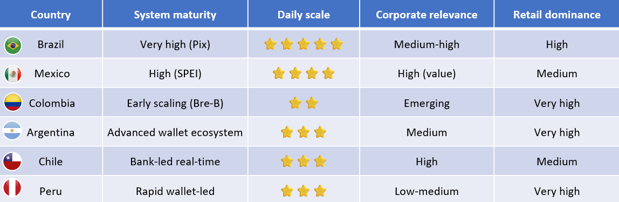
Comparison Table
Note : “Please note that while we strive to provide accurate and up-to-date information, we are not qualified tax advisers, and the content provided here should not be construed as professional tax advice. Tax laws and regulations are subject to change, and individual circumstances may vary. Therefore, it is recommended to consult with a certified tax professional or accountant for personalized guidance tailored to your specific situation. We do not accept any responsibility for the consequences of actions taken based on the information provided.”